Control Cabinets
Control Cabinets
Industrial Electrical Enclosures & Control Cabinets
Industrial Electrical Enclosures & Control Cabinets
The Cabinet Is Not Just a box—it directly affects system reliability.
In many industrial projects, electrical cabinets are treated as simple metal enclosures.
But in real operating environments, the cabinet itself often determines whether the entire control system remains stable over time.
Poor enclosure selection can lead to overheating, dust intrusion, corrosion, wiring congestion, difficult maintenance access, premature component failure, and long-term operational instability.
This is especially true in environments such as
- Outdoor utility systems
- Water treatment facilities
- Manufacturing plants
- Pump stations
- Oil & gas sites
- High-temperature industrial facilities
At UniRegal Automation, we provide industrial electrical enclosures and control cabinets designed not only to house components but also to support long-term system protection, maintainability, and operational reliability.
Our cabinet solutions are used in industrial automation systems, power distribution projects, infrastructure installations, machinery control systems, and utility applications where environmental protection and internal organization directly affect system performance.
Tips: Quick Facts
Parameter | Value |
|---|---|
Product Type | Industrial Electrical Enclosures & Control Cabinets |
Applications | Automation / Power Distribution / Utility Systems |
Installation | Indoor/Outdoor |
Material Options | Carbon Steel / Stainless Steel |
Protection Levels | IP20 / IP54 / IP65 / IP66 |
Cabinet Type | Wall-Mounted / Floor-Standing |
Custom Dimensions | Available |
Component Integration | PLC / VFD / Breakers / MCCB / Wiring |
Assembly Support | Empty or Fully Assembled Cabinets |
Why Cabinet Selection Matters More Than Many Buyers Expect
In industrial systems, components rarely fail in isolation.
Very often, long-term failures are caused by environmental and installation conditions that were underestimated during the cabinet selection stage.
Typical field problems include the following:
- VFD overheating due to poor ventilation
- Condensation inside outdoor cabinets
- Corrosion caused by humidity or chemical exposure
- Cable congestion making maintenance difficult
- Insufficient space for future expansion
- Incorrect IP rating selection
- Poor internal airflow
- Difficult installation access
- Dust contamination damaging electrical components
In many cases, the electrical components themselves are not the real problem.
The enclosure environment is.
That is why cabinet design should always be considered part of the control system — not a separate accessory.
Different Buyers Focus on Different Things
One reason enclosure projects often become complicated is because different industries care about very different priorities.
Understanding these differences early helps avoid expensive redesign later.
For System Integrators & Panel Builders
The biggest concern is usually installation efficiency and layout flexibility.
They often focus on:
- Internal mounting space
- Cable routing access
- DIN rail organization
- Ventilation planning
- Component compatibility
- Future expansion space
For these customers, cabinet layout directly affects assembly efficiency and future maintenance.
For Industrial End Users
The focus is usually long-term operational reliability.
Typical concerns include the following:
- Dust and water protection
- Heat management
- Corrosion resistance
- Ease of troubleshooting
- Long-term durability
- Spare component accessibility
Because downtime often costs far more than the cabinet itself.
For EPC Contractors & Infrastructure Projects
Project coordination and environmental suitability become critical.
They usually care about:
- Outdoor performance
- IP protection levels
- Delivery timeline stability
- Standardized cabinet sizing
- Documentation consistency
- Batch project delivery
- Compatibility with project specifications
In infrastructure projects, even small enclosure design mistakes can create major long-term maintenance issues.
Choosing the Right Cabinet Requires More Than Just Dimensions
Many buyers initially focus only on cabinet size.
In reality, enclosure selection should also consider the following:
1. Installation Environment
The operating environment directly affects enclosure lifespan and protection requirements.
Important considerations include:
- Indoor or outdoor installation
- Ambient temperature
- Humidity level
- Dust exposure
- Chemical or corrosive atmosphere
- Direct sunlight exposure
- Washdown requirements
For harsh environments, stainless steel and higher IP ratings are often necessary.
2. Heat Dissipation Requirements
Many industrial cabinets today contain:
- VFDs
- Servo drives
- PLC systems
- Power supplies
- Communication modules
These components generate heat continuously.
Poor airflow design can eventually cause the following:
- Overheating
- Random trips
- Reduced component lifespan
- Communication instability
Ventilation planning is often underestimated during early design stages.
3. Future Expansion Space
One of the most common long-term problems is lack of spare space.
A cabinet that appears sufficient today may become difficult to maintain after additional components are added later.
Good enclosure planning should consider:
- Spare DIN rail space
- Cable routing capacity
- Future PLC expansion
- Additional breakers
- Cooling upgrades
4. Maintenance Accessibility
In real facilities, technicians may interact with the cabinet for years.
That means the cabinet should support the following:
- Easy terminal access
- Clear component visibility
- Organized cable routing
- Proper maintenance spacing
- Easier troubleshooting
A clean internal layout often reduces downtime significantly during emergencies.
Common Cabinet Solutions by Application
Control Panel Cabinets
Designed for automation systems, PLC integration, machinery control, and industrial process systems.
Electrical Enclosures
Used for protecting breakers, relays, terminal blocks, and electrical distribution components.
Outdoor Control Cabinets
Built for field installations requiring weather resistance and environmental protection.
Stainless Steel Cabinets
Commonly used in:
- Water treatment
- Food processing
- Chemical plants
- Corrosive environments
- High-humidity facilities
Wall-Mounted Enclosures
Suitable for compact systems and smaller automation installations.
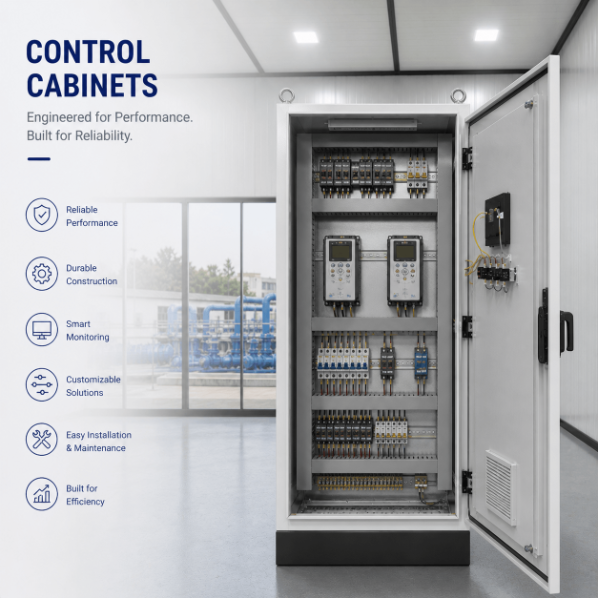
Typical Components Installed Inside
Our cabinets are commonly configured to support:
- PLC systems
- VFDs and soft starters
- Circuit breakers
- Motor protection devices
- Terminal blocks
- Power supplies
- Industrial communication devices
- SCADA control hardware
Cabinet layout is customized based on the component architecture and application requirements.
Configuration Options
Material Options
- Carbon Steel
- Stainless Steel
Protection Levels
- IP20
- IP54
- IP65
- IP66
Installation Types
- Wall-Mounted
- Floor-Standing
- Indoor Installation
- Outdoor Installation
Cabinet Dimensions
- Standard Sizes
- Fully Customized Dimensions
Designed for Global Industrial Projects
Our enclosure and cabinet solutions are used across multiple industrial sectors and regions.
Middle East
Outdoor utility and industrial systems operating in high-temperature and dusty environments.
Africa
Infrastructure and utility projects requiring durable enclosure systems.
Europe
Industrial automation projects emphasizing reliability and maintainability.
Asia
Manufacturing and production facilities requiring scalable cabinet solutions.
Empty Enclosures or Fully Integrated Systems
Depending on project requirements, we can provide the following:
Empty Enclosures
Suitable for panel builders and integrators handling their own internal assembly.
Pre-Machined Cabinets
Including cutouts, cable entry preparation, mounting plates, and ventilation configurations.
Fully Assembled Control Cabinets
Complete systems with installed components, wiring, testing, and labeling.
How We Help Reduce Long-Term Operational Risk
Better Environmental Protection
Proper enclosure selection helps reduce dust, humidity, corrosion, and overheating risks.
Improved Internal Organization
Well-planned layouts improve maintenance efficiency and troubleshooting speed.
Flexible Customization
Cabinets are configured around the actual application rather than generic dimensions.
Faster Project Coordination
We assist with enclosure sizing, layout planning, and project compatibility during the engineering stage.
Pre-Delivery Inspection
Assembled systems can undergo inspection and testing before shipment.
Frequently Asked Questions
Can the cabinet be customized for specific components?
Yes. Cabinet dimensions, internal layout, mounting plates, and cutouts can be customized based on your component configuration.
Are these cabinets suitable for outdoor use?
Yes. Outdoor cabinet solutions with higher IP ratings and weather-resistant materials are available.
What is the difference between carbon steel and stainless steel cabinets?
Carbon steel is more cost-effective for standard environments, while stainless steel offers stronger corrosion resistance for harsh or humid conditions.
Can you provide fully assembled cabinets?
Yes. We can provide empty enclosures, partially assembled systems, or fully wired control cabinets.
How do I choose the correct IP rating?
The required IP rating depends on the installation environment, dust exposure, humidity, and outdoor conditions. Higher ratings are generally recommended for harsh environments.
Before Requesting a Quotation
To help evaluate the correct cabinet solution, the following information is useful:
- Installation environment
- Indoor or outdoor installation
- Component list
- Cabinet dimensions (if available)
- Heat-generating components
- IP rating requirement
- Cable entry direction
- Material preference
- Mounting method
- Future expansion requirements
Even incomplete information is acceptable. Our engineering team can assist during the planning stage.
Start Your Cabinet Selection
Looking for reliable industrial electrical enclosures or control cabinets for your automation or power distribution project?
Contact UniRegal Automation today.
- Email: info@uniregal.com
- Website: https://www.uniregal.com