
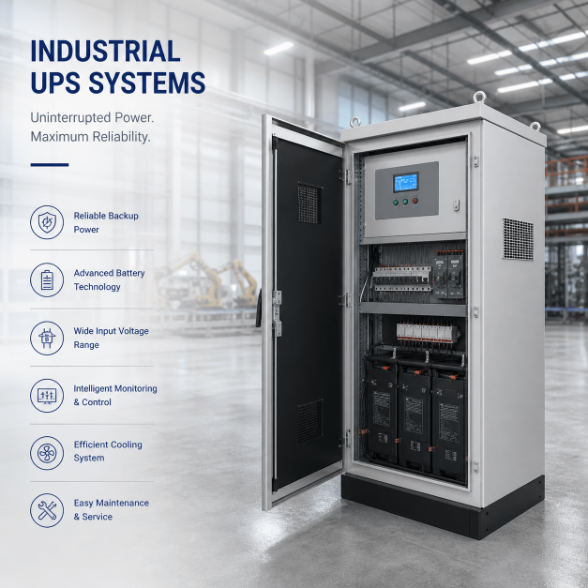
Industrial UPS
Industrial UPS Systems
Your Factory’s Heartbeat: Rugged Power Protection for Zero-Downtime Operations
Industrial UPS Systems | 100% Uptime for Mission-Critical Automation
Build Your Own Backup Power Architecture — Or Deploy a Fully Integrated Industrial UPS Solution?
In industrial environments, power problems are rarely limited to a complete blackout.
Most operational failures actually begin with the following:
- Voltage sags
- Harmonic distortion
- Frequency instability
- Short-duration power flickers
- Electromagnetic interference (EMI)
- Unstable generator switching
- Poor grounding conditions
For office equipment, these events may cause inconvenience.
For industrial automation systems, they can trigger the following:
- PLC crashes
- Corrupted machine logic
- Production line shutdowns
- Batch losses
- Servo faults
- SCADA communication interruptions
- Hours of recalibration and restart procedures
That is why industrial UPS systems are no longer viewed simply as “backup batteries.”
They are now considered part of the operational continuity strategy for mission-critical facilities.
At UniRegal Automation, we provide industrial-grade UPS systems engineered for harsh manufacturing environments, automation systems, process industries, infrastructure facilities, and mission-critical operations where even milliseconds of unstable power can create major production losses.
Industrial UPS Deployment Comparison Matrix
Decision Factor | Customer Self-Procurement & Integration | UniRegal Turnkey Industrial UPS Solution |
|---|---|---|
Total Cost of Ownership (TCO) | Lower upfront purchasing cost, but higher long-term integration, maintenance, battery replacement, and troubleshooting expenses. | Lower long-term operational costs through optimized UPS sizing, thermal management, and industrial-grade component selection. |
Project Deployment Timeline | Multiple suppliers and compatibility validation often extend installation and commissioning schedules. | Faster deployment with pre-engineered UPS systems designed for industrial integration from the beginning. |
Technical Integration Risk | Higher risk of undersized UPS systems, battery mismatch, grounding problems, or incompatible communication integration. | Reduced engineering risk through centralized system design, load analysis, and communication compatibility planning. |
Long-Term Maintenance Complexity | Maintenance depends heavily on internal engineering resources and third-party component coordination. | Easier long-term maintenance with standardized architecture, remote monitoring support, and integrated documentation. |
Compliance & Industrial Reliability Assurance | Industrial suitability and environmental compatibility may vary depending on selected hardware combinations. | UPS systems are engineered specifically for industrial environments with compliance and reliability considerations built into the solution. |
Supply Chain Stability | Procurement fragmentation can delay battery replacement, spare parts availability, and system expansion. | Centralized sourcing improves supply continuity and simplifies future support planning. |
System Scalability | Expansion often requires redesigning battery banks, bypass systems, or rack layouts. | Modular and expandable UPS architecture supports future capacity growth and redundancy planning. |
CAPEX vs OPEX Structure | Lower initial CAPEX, but higher long-term OPEX due to battery replacement cycles, downtime risk, and maintenance labor. | Better long-term operational efficiency through reduced downtime, predictive monitoring, and extended component lifespan. |
Why Many Industrial UPS Projects Become Expensive Later
One of the most common mistakes in industrial automation projects is treating the UPS system as a standard office backup device.
In reality, industrial power environments behave very differently.
Typical field problems include the following:
- UPS overheating inside electrical cabinets
- Premature battery failure due to high ambient temperature
- Harmonic distortion from large motors and welders
- Communication failures between UPS and SCADA systems
- Insufficient runtime calculations
- Incorrect UPS sizing for inrush current
- Poor battery management in remote installations
- Voltage instability during generator switching
These issues may not appear during initial startup.
They often begin appearing months later during continuous industrial operation.
That is why industrial UPS systems should always be engineered around the actual operating environment — not simply based on wattage alone.
Why Industrial Buyers Choose Turnkey UPS Solutions
Our turnkey industrial UPS systems are designed to reduce operational risk, simplify deployment, and improve long-term power stability.
Better Power Quality Protection
True online double-conversion architecture isolates sensitive PLCs, HMIs, and automation systems from dirty industrial power.
Improved Thermal Reliability
Industrial-grade thermal management helps maintain stable operation in high-temperature control cabinets and manufacturing environments.
Easier Integration with Automation Systems
UPS communication can integrate with:
- PLC systems
- SCADA platforms
- Building management systems
- Remote monitoring software
This improves visibility into battery health and operational status.
Reduced Maintenance Burden
Factory-engineered battery management and remote monitoring help reduce unexpected battery failures.
Better Long-Term Scalability
Expandable UPS architecture supports future automation growth and redundancy planning.
Featured Industrial UPS Solutions
Product Category | Best For | Key Advantage |
|---|---|---|
DIN-Rail UPS (DC/AC) | PLC & HMI Backup | Compact installation inside control cabinets |
Rugged Rackmount UPS | Industrial IT & Edge Computing | High-density power protection in 1U/2U format |
Modular Industrial UPS | Large Manufacturing Facilities | Hot-swappable modules for N+1 redundancy |
Outdoor Rated UPS | Oil & Gas / Telecom | IP65 protection for remote harsh environments |
Why Industrial UPS Is Different from Office UPS
One of the biggest misconceptions in industrial projects is assuming a commercial UPS can survive factory conditions.
In reality, industrial environments create challenges that office UPS systems were never designed to handle.
Industrial facilities often involve:
- High ambient temperatures
- Dust and vibration
- Motor-induced harmonics
- Electromagnetic interference
- Continuous operation
- Generator switching instability
Office UPS systems typically fail early under these conditions.
Industrial UPS systems are engineered with:
- Reinforced PCB protection
- Industrial capacitors
- High-temperature battery systems
- Ruggedized chassis
- Industrial cooling architecture
Because uptime in industrial environments is far more critical.
Lithium-Ion vs Lead-Acid Batteries
Battery selection directly affects long-term operating cost and maintenance strategy.
Lead-Acid (VRLA)
Typically selected for:
- Lower upfront cost
- Standard industrial environments
- Smaller UPS systems
However, batteries usually require replacement every 3–5 years.
Lithium-Ion (LiFePO₄)
Increasingly preferred for:
- Longer lifespan
- High-temperature environments
- Reduced maintenance
- Lower weight
- Better thermal performance
Many industrial facilities are shifting toward lithium systems to reduce long-term maintenance interruptions.
Solving “Dirty Power” in Industrial Facilities
Large industrial equipment such as the following:
- Welders
- Compressors
- Motors
- VFD systems
- Heavy machinery
can generate electrical noise, harmonics, and voltage instability.
Our online double-conversion UPS systems act as a power isolation layer.
Incoming power is continuously converted and regenerated into a stable sine wave output, helping sensitive automation systems avoid power-related instability.
Remote Monitoring & Predictive Maintenance
Modern industrial facilities increasingly require remote UPS visibility.
Our UPS systems can support:
- SNMP communication
- Modbus integration
- SCADA monitoring
- Battery health diagnostics
- Temperature monitoring
- Alarm notifications
This allows maintenance teams to identify battery degradation and system risks before failures occur.
Designed for Global Industrial Power Standards
North America
120V / 208V 60Hz systems with industrial safety considerations.
Europe & Asia
230V / 400V 50Hz systems designed for IEC-compliant industrial environments.
Harsh Industrial Regions
Specialized UPS systems for:
- High-sulfur paper mills
- High-altitude mining facilities
- Desert infrastructure
- Offshore installations
How We Help Reduce Long-Term Operational Risk
Better Runtime Planning
UPS systems are sized around real industrial loads and startup conditions rather than theoretical calculations.
Reduced Downtime Risk
Continuous online power conditioning helps reduce automation interruptions caused by unstable utility power.
Easier Maintenance & Monitoring
Remote diagnostics improve battery visibility and predictive maintenance planning.
Better Integration with Existing Systems
UPS communication architecture is designed for industrial automation environments.
Improved Long-Term Reliability
Industrial-grade components help extend service life under harsh operating conditions.
Download the Full Industrial UPS Comparison Report
Looking for a deeper evaluation of industrial UPS deployment strategy, lithium vs. VRLA battery systems, runtime planning, or dirty power protection for automation facilities?
Download the full comparison report or schedule a technical consultation with our engineering team to discuss your project requirements.
Contact UniRegal Automation
- Email: info@uniregal.com
- Website: https://www.uniregal.com