PLC Control Panels
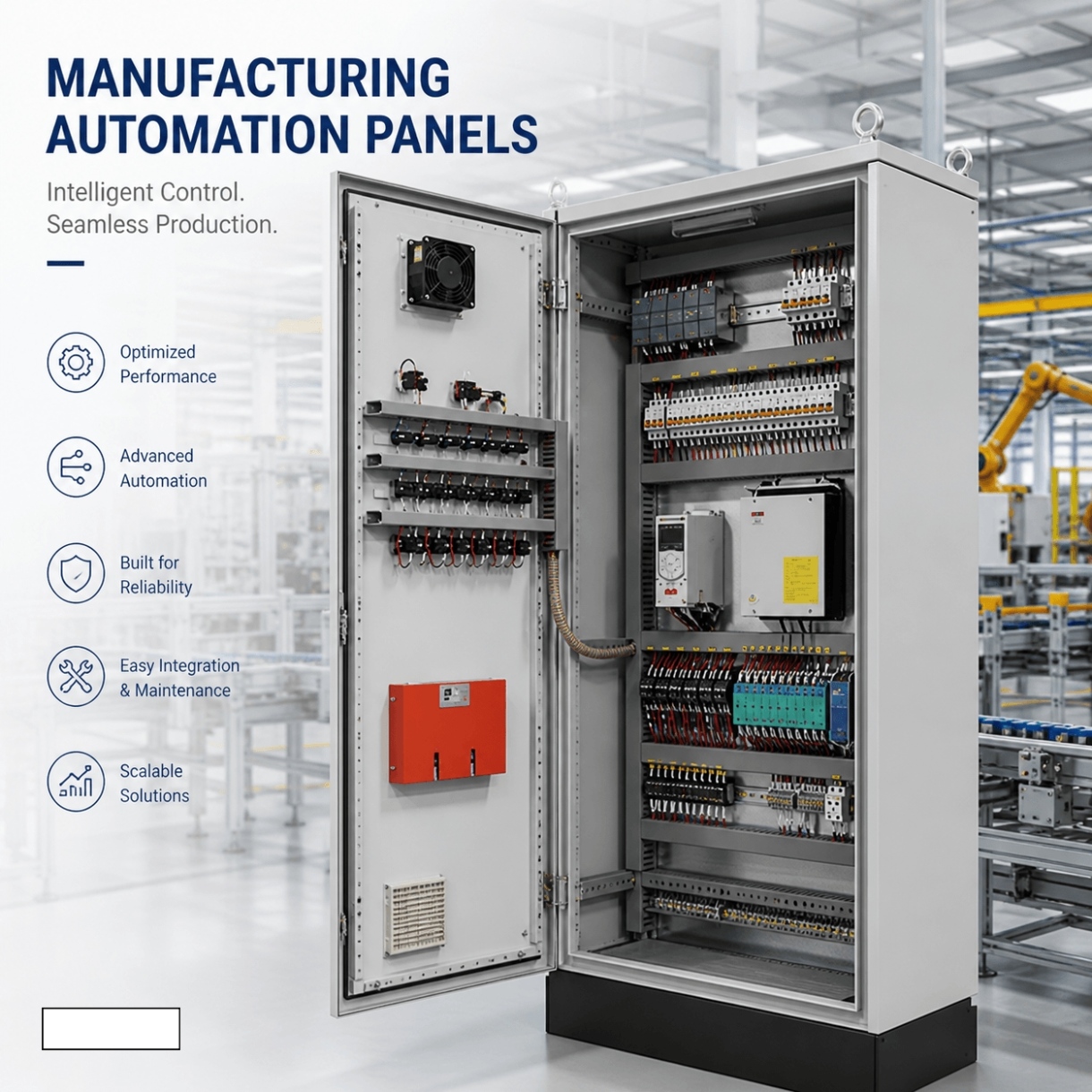
Manufacturing Automation Panels
Control panels for production lines and factory automation systems
Specifications
- Service Duration
- 4-8 months
- Service Content
- Current state analysis, solution design, implementation guidance
- Deliverables
- Optimization plan, process documentation, system configuration
Manufacturing Automation Panels
Automation Control Panels Built for Production Lines Where Downtime Directly Impacts Output
In modern manufacturing environments, production stability is everything.
A single control failure can stop an entire production line, delay shipments, increase labor costs, create quality inconsistencies, and reduce factory efficiency.
For manufacturers, the real challenge is not simply automating machines.
The challenge is building a production system that can operate continuously, communicate reliably, adapt to changing production demands, and remain maintainable over the long term.
At UniRegal Automation, we provide custom manufacturing automation panels designed for factories, OEM equipment, and industrial production systems where uptime, integration stability, and operational efficiency matter.
What Manufacturing Buyers Actually Care About
Most factories today already have machines.
What they struggle with is making different systems operate together reliably.
Typical production challenges include:
- Frequent production downtime
- Unstable communication between machines
- Bottlenecks between production stages
- Difficult troubleshooting during operation
- Old machines unable to integrate with newer systems
- Poor visibility into production status
- Wiring confusion during maintenance
- Delays caused by replacement incompatibility
- Lack of scalability for future expansion
- Production losses caused by unstable automation systems
For factory managers, system integrators, and OEM manufacturers, these problems directly affect output, labor efficiency, and delivery performance.
That is why manufacturing automation panels must be designed around real production workflows — not just electrical assembly.
Designed Around Continuous Production Stability
Manufacturing environments operate differently from standard industrial applications.
Production systems often require the following:
- Continuous 24/7 operation
- Fast machine coordination
- Real-time signal communication
- Stable motor and conveyor control
- Flexible production logic
- Future line expansion capability
- Fast maintenance response
- Minimal downtime during upgrades
Our automation panels are designed with these operational realities in mind.
We focus on:
- Stable PLC communication
- Reliable signal management
- Logical internal wiring structures
- Easy maintenance access
- Expandable control architecture
- Long-term component reliability
- Flexible integration with existing systems
This helps reduce production interruptions while improving operational efficiency.
Typical Manufacturing Applications
Automated Production Lines
Centralized automation control for multi-machine manufacturing processes.
Assembly & Packaging Systems
Integrated control for assembly stations, packaging equipment, labeling systems, and material flow management.
Conveyor & Material Handling Systems
Stable coordination for conveyors, transfer systems, sorting equipment, and automated handling applications.
CNC & Machine Tool Systems
Control panels for precision manufacturing equipment and industrial machining systems.
Robotic & Semi-Automated Systems
Automation panels supporting robotic cells, collaborative systems, and flexible manufacturing operations.
More Than Just a Control Panel
For many manufacturing projects, the control panel becomes the communication center of the production line.
That means buyers are not only evaluating hardware.
They are evaluating:
Can the system reduce downtime?
Stable communication architecture and organized wiring help reduce troubleshooting time during failures.
Will it integrate with existing equipment?
We support integration with existing PLCs, sensors, VFDs, HMIs, and factory automation systems.
Can operators maintain the system easily?
Maintenance-friendly panel design improves accessibility, identification, and servicing efficiency.
Can the system expand later?
Expandable I/O and flexible architecture support future production upgrades.
Will the supplier understand industrial production realities?
We focus on practical factory operation, not only electrical specifications.
Automation System Capabilities
Each manufacturing automation panel is configured based on your production requirements.
Control Systems
- PLC-Based Automation Control
- HMI Operator Interfaces
- Multi-Machine Coordination
- Servo & Motion Control
- Conveyor Logic Control
- Alarm & Monitoring Systems
Communication & Integration
- SCADA Integration
- MES Communication
- Ethernet/IP
- Modbus
- Profibus
- Industrial Ethernet
- Remote Monitoring Options
Expandable System Architecture
Designed to support:
- Future machine additions
- Extra sensors and actuators
- Additional production zones
- Production line expansion
- Retrofit upgrades
Multi-Brand Automation Support
Modern factories often use mixed automation platforms.
We support integration with major industrial automation brands, including:
- Siemens
- Mitsubishi
- Omron
- Schneider Electric
- ABB
- Allen-Bradley
- Delta
- Weintek
- Keyence
This helps customers simplify upgrades and maintain compatibility with existing equipment.
Built for Global Manufacturing Projects
Different manufacturing industries and regions face different operational priorities.
North America
Standardized automation systems focused on reliability and maintainability.
Europe
Precision manufacturing environments requiring stable process control and detailed system integration.
Asia
High-volume production lines focused on efficiency and scalability.
Middle East & Industrial Expansion Projects
New production facilities requiring flexible automation architecture and fast implementation.
How We Help Reduce Manufacturing Risk
Better Production Stability
Reliable automation systems help reduce unexpected production interruptions.
Easier Troubleshooting
Clear wiring layouts and organized panel structures improve maintenance efficiency.
Faster System Integration
Support for multiple communication protocols and automation platforms helps simplify machine integration.
Reduced Upgrade Complexity
Expandable architecture allows future production expansion without complete system redesign.
Pre-Delivery Testing
Panels undergo inspection and functional testing before shipment to improve startup reliability.
Engineering & Project Support
We support manufacturing projects through multiple stages:
- Production process review
- Automation logic discussion
- Electrical design support
- Component selection
- Panel assembly & wiring
- Functional testing
- Communication verification
- Export packaging
- Technical documentation support
For OEM manufacturers and large-scale production projects, standardized panel production can also be supported.
Inspection & Functional Testing
Each panel undergoes inspection before shipment.
Testing may include:
Wiring Verification
Checking terminal connections, labeling accuracy, and internal organization.
Functional Testing
Testing control logic, signal response, and operational behavior.
Communication Verification
Verifying PLC, HMI, VFD, SCADA, and industrial network communication.
Power-On Testing
Basic operational verification before delivery.
Packing & Export Review
Ensuring protection during international shipment.
Frequently Asked Questions
Can the panel integrate with our existing production line?
Yes. Panels can be designed to match your current automation architecture and communication protocols.
Do you support multiple automation brands in one project?
Yes. Multi-brand integration is supported depending on your existing equipment and project requirements.
Can the system support future expansion?
Yes. Panels can be designed with expandable I/O and flexible architecture for future production upgrades.
How do you help reduce production downtime?
We focus on stable communication, organized wiring, practical maintainability, and pre-delivery testing to reduce operational risks.
What industries typically use these systems?
Our panels are widely used in packaging, automotive, electronics, food processing, industrial manufacturing, and OEM production systems.
Start Your Automation Project
Looking for a reliable manufacturing automation panel supplier for your production system?
Contact UniRegal Automation today.
- Email: info@uniregal.com
- Website: https://www.uniregal.com