
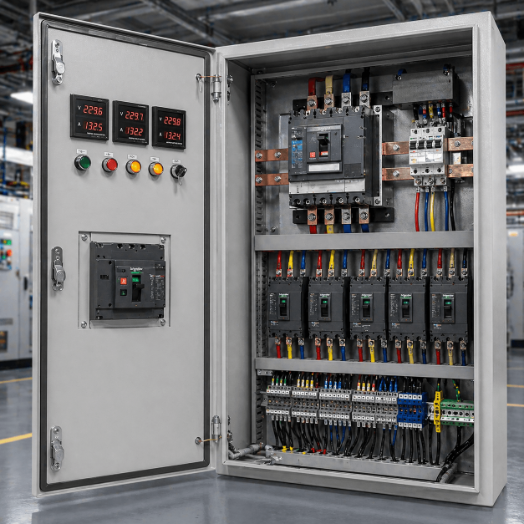
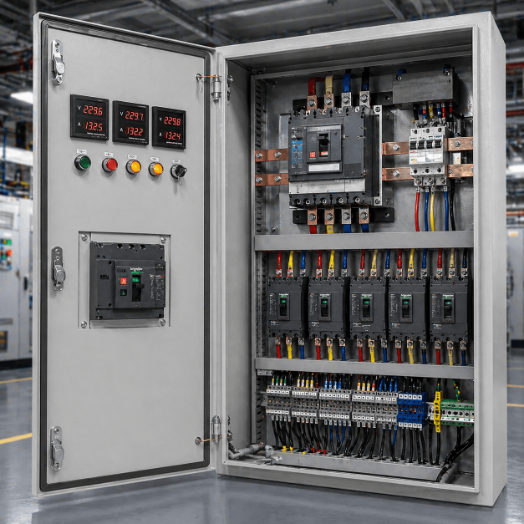
MCC Panels
MCC Panels (Motor Control Centers)
MCC Panels (Motor Control Centers) for Industrial Power & Motor Control Systems
MCC Panels (Motor Control Centers)
Industrial MCC Panels Designed for Long-Term Motor Control Reliability
In many industrial facilities, production does not stop because of one machine.
It stops because one motor fault spreads across the system and affects pumps, conveyors, compressors, fans, or entire production sections.
That is why MCC panels are not simply electrical cabinets.
They are long-term operational systems designed to manage motor control, power distribution, protection coordination, maintenance accessibility, and future expansion across the entire facility.
At UniRegal Automation, we build custom MCC panels for industrial environments where uptime, electrical stability, and long-term maintainability are critical.
Our MCC systems are widely used in manufacturing plants, water treatment facilities, oil & gas projects, mining operations, and large infrastructure systems where multiple motors must operate reliably under continuous industrial conditions.
Most MCC problems do not appear during startup.
One of the biggest misconceptions in industrial projects is assuming that a successful startup means the MCC system is properly designed.
In reality, many MCC-related problems only begin appearing months later during actual plant operation.
Common long-term issues include:
- Busbar overheating
- VFD heat accumulation
- Poor fault isolation
- Difficult maintenance access
- Unclear feeder identification
- Expansion limitations
- Cable congestion
- Unstable communication between systems
- Excessive downtime during motor failures
- Inconsistent component standards across sections
This is why MCC design is not simply about fitting starters into a cabinet.
It is about building a motor control system that can remain stable, maintainable, and expandable for years.
What Industrial Buyers Usually Care About Before Choosing an MCC Supplier
Most industrial buyers are not just evaluating hardware specifications.
They are evaluating operational risk.
Typical concerns include the following:
- Will the MCC remain stable under continuous operation?
- Can the system isolate faults without affecting the entire process?
- How difficult will maintenance become after installation?
- Will future motor expansion require a complete redesign?
- Can VFD sections operate safely without overheating?
- Will spare parts remain available later?
- Can the panel integrate with existing PLC or SCADA systems?
- Will troubleshooting be manageable for plant technicians?
These questions matter because MCC systems often remain in operation for 10–20 years.
Poor early design decisions can create operational problems for the entire lifespan of the facility.
Tips: Quick Facts
Parameter | Value |
|---|---|
Product Type | MCC Panels / Motor Control Centers |
Main Function | Centralized Multi-Motor Control |
Voltage Range | 220V–480V |
Protection Level | IP54 / IP65 |
Starter Types | DOL / Star-Delta / Soft Starter / VFD |
Communication | Modbus / Ethernet / SCADA |
Installation | Indoor/Outdoor |
Expansion Support | Available |
Testing | Functional & Protection Testing |
Where MCC Panels Are Commonly Used
Manufacturing Plants
Coordinated motor control for conveyors, compressors, mixers, production lines, and automated machinery.
Water Treatment & Pump Stations
Reliable operation for multiple pumps, blowers, and utility systems requiring continuous operation.
Oil & Gas Facilities
Motor control systems for compressors, transfer pumps, processing systems, and industrial utilities.
Mining & Heavy Industry
High-load industrial environments where operational stability and motor protection are critical.
HVAC & Large Building Systems
Centralized motor control for fans, chillers, cooling towers, and large mechanical systems.
Why MCC Architecture Matters More Than Many Buyers Expect
The quality of an MCC system is not determined by appearance alone.
The internal architecture directly affects:
- Operational reliability
- Fault isolation
- Heat management
- Maintenance efficiency
- Expansion flexibility
- Downtime recovery speed
- Electrical safety
- Long-term operating cost
A well-designed MCC should make future operation easier—not more complicated.
Typical MCC Architecture
A modern MCC system may include the following:
Section | Function |
|---|---|
Incoming Section | Main power isolation and protection |
Busbar System | Centralized power distribution |
Motor Feeder Units | Individual motor control |
VFD Compartments | Variable speed motor applications |
PLC/SCADA Section | Monitoring and communication |
Spare Feeder Sections | Future motor expansion |
Utility Section | Auxiliary power and control systems |
The layout strategy becomes especially important in large facilities where future expansion and maintenance access must be considered from the beginning.
Key Engineering Considerations Before Building an MCC Panel
1. Future Expansion Planning
Many facilities underestimate future motor growth.
An MCC that is fully occupied on day one may become a serious operational limitation only a few years later.
Planning spare feeder sections early is usually far less expensive than rebuilding the system later.
2. Fault Isolation Strategy
In continuous production environments, one feeder fault should not affect adjacent motor sections.
Proper protection coordination and compartment separation help reduce unnecessary downtime.
3. VFD Heat Management
VFD compartments generate significant heat during operation.
Poor ventilation design can eventually lead to overheating, nuisance trips, or shortened component lifespan.
4. Maintenance Accessibility
MCC systems are expected to remain serviceable for many years.
That means technicians still need the following:
- Clear terminal visibility
- Cable access
- Logical feeder labeling
- Maintenance spacing
- Easier replacement access
Long after installation is complete.
5. Communication & Monitoring Integration
Modern industrial systems often require integration with:
- PLC systems
- SCADA platforms
- Remote monitoring
- Alarm systems
- Industrial Ethernet networks
Stable communication architecture becomes increasingly important as facilities become more automated.
Conventional MCC vs Intelligent MCC
Conventional MCC
Typically suitable for:
- Basic motor control
- Simpler industrial systems
- Standard protection applications
- Facilities with minimal monitoring requirements
Intelligent MCC
Designed for facilities requiring:
- Real-time monitoring
- Remote diagnostics
- Predictive maintenance
- SCADA integration
- Advanced fault detection
- Energy monitoring
- Faster troubleshooting
Intelligent MCC systems help operators identify problems faster and reduce downtime during failures.
Typical MCC Configurations
Depending on the application, MCC panels may include the following:
- DOL Starter Sections
- Star-Delta Starter Sections
- Soft Starter Units
- VFD Compartments
- Motor Protection Relays
- PLC Integration
- SCADA Communication
- Remote Monitoring Systems
- Power Distribution Sections
Multi-Brand Component Flexibility
We support flexible integration with major industrial automation and motor control brands, including:
- Siemens
- ABB
- Schneider Electric
- Mitsubishi
- Allen-Bradley
- Omron
- Eaton
- Delta
This flexibility is especially valuable for retrofit projects and facilities operating mixed automation platforms.
Designed for Global Industrial Projects
Our MCC panels are used in industrial projects across multiple regions:
Middle East
Oil, gas, desalination, and infrastructure systems operating under high temperatures and dusty conditions.
Africa
Mining and infrastructure facilities requiring durable motor control systems.
Europe
Industrial manufacturing environments focus on long-term reliability and maintainability.
North America
Automation-driven facilities emphasizing safety, standardization, and operational consistency.
How We Help Reduce Long-Term Operational Risk
Better Protection Coordination
Proper protection design helps reduce nuisance trips and equipment damage.
Easier Maintenance
Organized feeder layouts and clear labeling improve troubleshooting efficiency.
Stable VFD Integration
Attention to cooling and communication layout helps reduce long-term instability.
Future Expansion Flexibility
Expandable architecture helps avoid costly redesign during plant growth.
Pre-Delivery Testing
Each system undergoes functional testing and inspection before shipment to reduce startup risk.
Engineering & Integration Support
We support MCC projects from early-stage engineering through final delivery.
Support may include:
- Motor load review
- Single-line diagram review
- MCC architecture planning
- Component selection
- PLC & SCADA integration
- Functional testing
- Documentation support
- Export packaging
- Delivery coordination
Frequently Asked Questions
Can the MCC system be expanded later?
Yes. MCC panels can be designed with spare feeder sections and expandable architecture for future motor additions.
What is the difference between conventional and intelligent MCC systems?
Traditional MCC systems focus on basic motor control, while intelligent MCC systems support monitoring, diagnostics, communication, and predictive maintenance.
Can VFDs be integrated into the MCC?
Yes. MCC systems can include dedicated VFD compartments for variable-speed motor applications.
How do you improve system safety?
Panels include protection systems such as overload relays, breakers, fault detection, and coordinated protection logic.
Can MCC panels operate in harsh industrial environments?
Yes. Panels can be configured for high-temperature, dusty, humid, and outdoor industrial conditions.
Before Requesting a Quotation
To reduce engineering revisions and quotation delays, it is helpful to prepare:
- Motor list
- Motor power ratings
- Starting method requirements
- Single-line diagrams
- Voltage & frequency
- Indoor or outdoor installation
- Communication requirements
- Future expansion plans
- Preferred component brands
- Project location
Even incomplete information is acceptable. Our engineering team can assist during the evaluation stage.
Start Your MCC Project
Looking for a reliable MCC panel supplier for your industrial motor control system?
Contact UniRegal Automation today.
- Email: info@uniregal.com
- Website: https://www.uniregal.com