
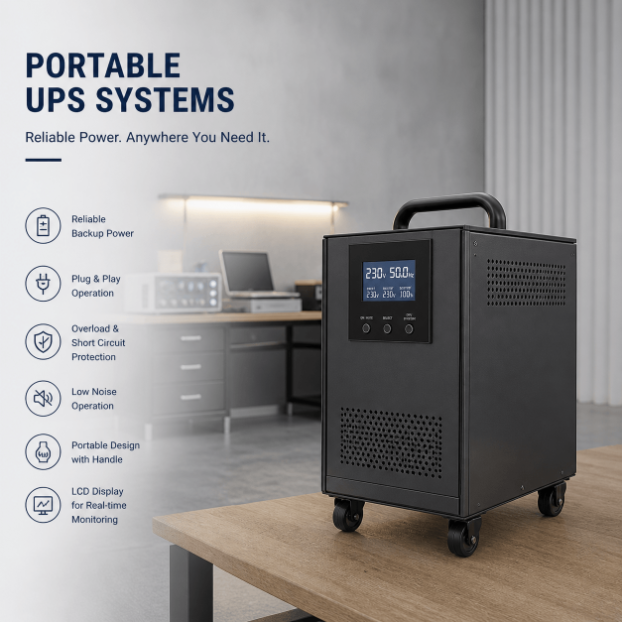
Portable UPS Systems
Portable UPS Systems
Power Without Boundaries
UNIREGAL PORTABLE UPS SERIES | Power Without Boundaries
Build Your Own Portable Power Setup — Or Deploy a Ready-to-Work Mobile Energy System?
Portable power is no longer just about charging devices.
In modern industrial, infrastructure, emergency response, and remote field operations, portable UPS systems have become critical operational tools for keeping equipment, communications, diagnostics, and field systems running where stable grid power simply does not exist.
Many organizations initially attempt to build their own mobile power solutions by combining:
- Consumer battery packs
- Inverters
- Solar chargers
- External battery modules
- Generator backup systems
At first, this may appear more flexible or lower cost.
However, in real-world field environments, portable power reliability depends heavily on how well the entire system is engineered, protected, monitored, and integrated.
At UniRegal Automation, our Portable UPS Series is designed as a complete industrial-grade mobile power platform built for remote operations, field engineering, emergency infrastructure, telecommunications, industrial maintenance, and off-grid deployment where stable portable energy matters more than marketing specifications.
Portable UPS Deployment Comparison Matrix
Decision Factor | Customer Self-Procurement & Integration | UniRegal Turnkey Portable UPS Solution |
|---|---|---|
Total Cost of Ownership (TCO) | Lower upfront purchasing cost, but higher long-term replacement, compatibility, and maintenance expenses. | Lower lifecycle operating costs through integrated LiFePO₄ battery systems, industrial-grade components, and optimized power management. |
Project Deployment Timeline | Multiple suppliers and manual integration increase setup and testing time. | Ready-to-deploy portable power systems reduce field preparation and deployment delays. |
Technical Integration Risk | Higher risk of inverter mismatch, unstable charging behavior, battery imbalance, or unsafe field wiring. | Reduced technical risk through factory-integrated battery management, charging systems, and pure sine wave power architecture. |
Long-Term Maintenance Complexity | Maintenance depends heavily on field troubleshooting and mixed hardware compatibility. | Simplified maintenance with centralized system architecture and integrated monitoring functions. |
Compliance & Operational Reliability | Consumer-grade systems may not tolerate industrial vibration, temperature, or harsh outdoor environments. | Engineered for demanding field environments with ruggedized chassis and industrial-grade thermal protection. |
Supply Chain Stability | Replacement batteries, inverters, or accessories may vary across suppliers and product generations. | A unified sourcing strategy improves long-term compatibility and spare support. |
System Scalability | Expansion often requires external modifications and compatibility verification. | Modular expansion and solar integration can be planned during initial system configuration. |
CAPEX vs OPEX Structure | Lower initial CAPEX, but potentially higher long-term OPEX from battery replacement, downtime, and field failures. | Better long-term operational efficiency through extended battery lifespan and reduced field maintenance costs. |
Why Portable Power Systems Often Fail in Real Field Conditions
Many portable power systems perform well in controlled showroom demonstrations.
But real industrial and infrastructure environments introduce challenges that consumer-grade battery systems were never designed to survive.
Typical field problems include the following:
- Battery overheating under direct sunlight
- Modified sine wave instability damaging sensitive electronics
- Poor runtime accuracy under changing loads
- Inverter shutdown during motor startup surges
- Dust and moisture intrusion
- Battery degradation after repeated deep cycling
- Inconsistent solar charging behavior
- Vibration damage during transportation
For field engineers and infrastructure operators, power instability in remote locations can stop the entire operation.
That is why industrial portable UPS systems should be engineered around real deployment environments—not only battery capacity numbers.
Why Industrial Buyers Choose Turnkey Portable UPS Solutions
Our portable UPS systems are designed to reduce operational risk while improving mobility, runtime stability, and deployment flexibility.
True Portable Industrial Power
Unlike fixed UPS systems or noisy generators, portable UPS units allow critical equipment to operate wherever the work moves.
Clean Power for Sensitive Equipment
True pure sine wave output protects the following:
- PLC systems
- Laptops
- Sensors
- Communication devices
- Diagnostic tools
- Medical electronics
- Industrial instrumentation
from unstable power conditions.
Better Long-Term Battery Strategy
Industrial-grade LiFePO₄ battery systems offer:
- Longer lifespan
- Higher thermal stability
- Reduced maintenance
- Better deep-cycle durability
compared with traditional lead-acid systems.
Silent & Zero-Emission Operation
Portable UPS systems eliminate:
- Generator noise
- Fuel logistics
- Exhaust fumes
- Indoor safety concerns
making them suitable for indoor, urban, and environmentally regulated environments.
Flexible Off-Grid Deployment
Systems can operate through:
- Solar charging
- Vehicle charging
- Grid charging
- Hybrid charging strategies
depending on the project environment.
Portable UPS Product Series
Product Series | Best For | Key Advantage |
|---|---|---|
Explorer Series | Field laptops, testers, drones | Lightweight and highly portable |
Commander Series | Power tools, mobile medical units | Rugged chassis with industrial durability |
Solar-Ready Series | Remote off-grid sites | Integrated MPPT solar charging support |
Why Portable UPS Is Different from Consumer Battery Stations
One of the biggest mistakes in field operations is assuming that all portable power systems are equally suitable for industrial use.
Most consumer battery stations are optimized for occasional home or recreational use.
Industrial environments introduce completely different challenges:
- High ambient temperatures
- Dust exposure
- Transportation vibration
- Heavy cycling
- Continuous runtime demands
- Sensitive industrial electronics
- Motor startup surges
That is why industrial portable UPS systems require the following:
- Ruggedized chassis
- Thermal protection
- Industrial-grade BMS architecture
- Reinforced internal protection
- Stable pure sine wave inverters
- Long-cycle battery systems
because operational failure in the field can become extremely expensive.
Solving Real Field Power Problems
Replacing Gas Generators for Mobile Operations
For many field applications, portable UPS systems offer major advantages over traditional generators:
- Silent operation
- Zero emissions
- No fuel handling
- Stable voltage output
- Indoor-safe operation
- Reduced maintenance
This is especially valuable for:
- Remote diagnostics
- Emergency response
- Mobile clinics
- Telecom maintenance
- Urban construction zones
Power Quality Matters More Than Many Buyers Realize
Cheap battery systems often use modified sine wave output.
This can create:
- Motor overheating
- PLC instability
- Sensor communication problems
- Laptop charging issues
Our systems use true pure sine wave technology designed for sensitive industrial electronics and automation systems.
Flexible Charging for Remote Operations
Portable UPS systems can recharge through multiple power sources:
Solar Charging
Integrated MPPT controllers support efficient off-grid charging.
Vehicle Charging
12V / 24V vehicle charging during transport or remote operations.
Grid Fast Charging
Rapid recharge before field deployment.
Designed for Harsh Global Environments
North America
Emergency telecom backup, HVAC diagnostics, and industrial field maintenance.
Middle East & Africa
Remote mining, infrastructure, and off-grid industrial operations.
Europe
Urban projects requiring low-noise and zero-emission field power systems.
How We Help Reduce Long-Term Operational Risk
Better Runtime Stability
Industrial-grade power architecture improves operational reliability under varying field loads.
Reduced Battery Replacement Frequency
LiFePO₄ systems significantly extend service life compared with lead-acid alternatives.
Easier Field Deployment
Integrated systems reduce setup complexity and field wiring risk.
Improved Equipment Protection
Pure sine wave output protects sensitive electronics and automation equipment.
Flexible Expansion Capability
Solar integration and modular expansion support future operational growth.
Download the Full Portable UPS Comparison Report
Looking for a deeper evaluation of portable industrial power strategy, LiFePO₄ battery systems, generator replacement planning, or off-grid deployment solutions?
Download the full comparison report or schedule a technical consultation with our engineering team to discuss your project requirements.
Contact UniRegal Automation
- Email: info@uniregal.com
- Website: https://www.uniregal.com