VFD Control Panels
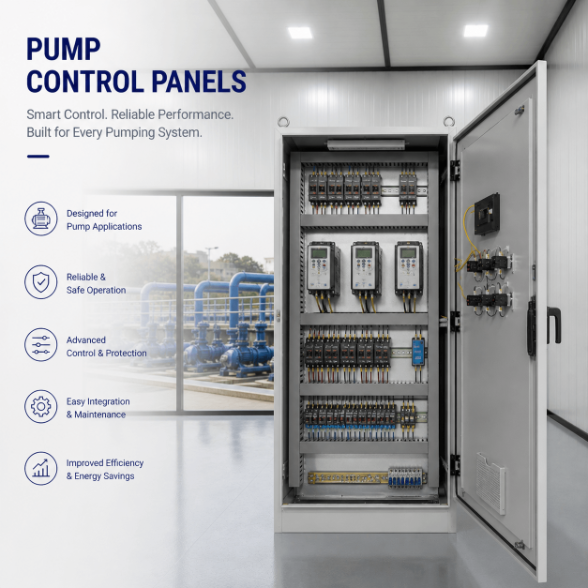
Pump Control Panels
Pump Control Panels for Industrial Water & Fluid Management Systems
Pump Control Panels
Stable Pump Operation Is Usually About the Control system—not the pump itself.
In many water and industrial fluid systems, the pump is not the real problem.
The real problems usually come from unstable control logic, incorrect pressure management, poor protection settings, communication failures, or badly designed pump sequencing.
This is why two systems using the same pump can perform completely differently in real operation.
At UniRegal Automation, we build custom pump control panels designed for industrial water systems, wastewater facilities, irrigation projects, HVAC circulation systems, and fluid transfer applications where stable operation and long-term reliability are critical.
Our systems are designed not only to start and stop pumps but also to help reduce pressure instability, prevent unnecessary pump damage, simplify maintenance, and improve overall system efficiency.
What Pump System Buyers Usually Worry About
Most buyers are not simply looking for a “pump starter panel.”
They are trying to avoid operational problems like the following:
- Pumps frequently starting and stopping
- Unstable water pressure
- Dry-run damage
- Water hammer problems
- Pumps wearing out too quickly
- Difficult troubleshooting during failures
- Multiple pumps operating inefficiently
- High electricity consumption
- Overflow or low-level shutdown problems
- Communication failures with SCADA systems
In many facilities, these issues create far more cost than the panel itself.
That is why pump control systems must be designed around operational stability — not just electrical control.
Tips: Quick Facts
Parameter | Value |
|---|---|
Product Type | Pump Control Panels |
Applications | Water, Wastewater, Irrigation, HVAC |
Pump Support | Single Pump / Multi-Pump |
Control Type | Relay / PLC / VFD |
Protection Level | IP54 / IP65 / IP66 |
Functions | Pressure Control / Alternation / Alarm |
Communication | Modbus / Ethernet / SCADA |
Installation | Indoor/Outdoor |
Customization | Available |
Why Many Pump Control Systems Become Unstable Over Time
A pump control panel may work perfectly during initial startup.
But real problems often begin later during continuous operation.
Typical long-term issues include:
- Incorrect pump alternation logic
- VFD parameter mismatch
- Pressure fluctuations
- Sensor signal instability
- Poor cable shielding
- Excessive pump cycling
- Improper dry-run protection
- Heat buildup inside the enclosure
- Difficult fault identification during emergencies
In many cases, the issue is not the pump.
It is the control strategy behind the pump system.
Choosing the Right Pump Control Method Matters
Different pump applications require very different control strategies.
Using the wrong control method often creates unnecessary wear, unstable pressure, and energy waste.
Single Pump Control Panels
Typically used for:
- Small transfer systems
- Basic water supply
- Simple industrial applications
Best for systems with stable operating conditions and limited automation requirements.
Dual Pump Alternating Systems
Designed for:
- Duty/standby applications
- Redundancy systems
- Reduced pump wear
- Improved operational reliability
Automatic alternation helps balance operating hours between pumps.
Multi-Pump Control Systems
Used in larger systems requiring:
- Load balancing
- Pressure stabilization
- Sequential pump operation
- Variable demand management
Especially common in municipal water and industrial pumping systems.
VFD Pump Control Panels
Widely used for:
- Constant pressure systems
- Energy-saving applications
- Variable flow demand
- Reduced mechanical stress
VFD systems help improve pressure stability while lowering power consumption.
What Should Be Confirmed Before Designing a Pump Control Panel?
One of the biggest causes of project delays is incomplete system information during the engineering stage.
The following details are extremely important:
1. Pump Quantity & Power Ratings
Buyers should ideally confirm:
- Number of pumps
- Pump motor power
- Operating sequence
- Duty/standby requirements
- Future expansion plans
This directly affects panel sizing and protection design.
2. Control Objective
Different systems prioritize different goals:
- Constant pressure
- Level control
- Flow control
- Irrigation timing
- Booster pressure management
- Wastewater sequencing
The control strategy should match the actual process requirement.
3. Sensor & Instrumentation Information
Pump control systems often rely on the following:
- Pressure transmitters
- Level sensors
- Float switches
- Flow meters
Signal type and sensor reliability directly affect system stability.
4. Installation Environment
Pump systems may operate in the following:
- Outdoor pump stations
- High-humidity environments
- Dusty industrial sites
- Flood-prone areas
- Hot climates
This affects:
- IP rating selection
- Cooling requirements
- Enclosure material
- Long-term reliability
5. Communication & Monitoring Requirements
Modern pump systems increasingly require the following:
- SCADA integration
- Remote monitoring
- Alarm notification
- PLC communication
- Building management integration
Stable communication architecture becomes especially important for unattended systems.
Typical Pump Control Applications
Water Supply Systems
Stable pressure control for municipal and commercial water distribution systems.
Wastewater Treatment Plants
Pump sequencing and level control for wastewater handling systems.
Booster Pump Stations
Pressure management systems for large buildings and utility infrastructure.
Irrigation Systems
Automated pump operation for agricultural and landscape irrigation systems.
Industrial Fluid Transfer
Reliable transfer control for industrial liquids and process fluids.
HVAC Water Circulation Systems
Pump control for chilled water, cooling loops, and circulation systems.
Key Functional Capabilities
Depending on project requirements, systems may support the following:
- Automatic & manual operation
- Pump alternation logic
- Constant pressure control
- Dry-run protection
- Overload protection
- Fault alarms
- Level-based operation
- Pressure-based sequencing
- SCADA integration
- Remote monitoring
Multi-Brand Integration Support
We support flexible integration with major industrial automation brands, including:
- Siemens
- Schneider Electric
- ABB
- Mitsubishi
- Omron
- Allen-Bradley
- Delta
- Weintek
This is especially useful for retrofit projects and facilities operating mixed automation platforms.
Designed for Global Water & Industrial Projects
Our pump control panels are used in projects across multiple regions:
Middle East
Water supply and irrigation systems operating under high temperatures and dusty conditions.
Africa
Infrastructure and utility projects requiring stable pump operation.
Southeast Asia
Industrial water systems and municipal utility projects.
Europe & North America
Standardized automation systems requiring stable communication and maintainability.
How We Help Reduce Long-Term Operational Risk
Better Pump Protection
Protection logic helps reduce dry-run damage, overload conditions, and abnormal operation.
Improved Pressure Stability
Well-designed VFD and control logic help reduce pressure fluctuation problems.
Easier Troubleshooting
Organized wiring and clear alarm systems improve maintenance efficiency.
Future Expansion Flexibility
Expandable architecture supports future pump additions and system upgrades.
Pre-Delivery Testing
All systems undergo inspection and functional testing before shipment to reduce startup risks.
Engineering & Project Support
We support pump control projects from early-stage discussion through final delivery.
Support may include:
- Pump system review
- Control logic discussion
- Component selection
- PLC & HMI integration
- VFD parameter support
- Functional testing
- Communication verification
- Documentation support
- Export packaging
Frequently Asked Questions
Can the panel control multiple pumps automatically?
Yes. Multi-pump systems can be configured with automatic alternation and load balancing logic.
Is VFD control available for constant-pressure systems?
Yes. VFD pump control panels are widely used for stable, constant-pressure applications and energy efficiency improvement.
Can the system integrate with sensors and SCADA platforms?
Yes. Panels can integrate with pressure transmitters, level sensors, flow meters, SCADA systems, and remote monitoring platforms.
How do you protect pumps from damage?
Protection functions may include overload protection, dry-run protection, phase failure detection, fault alarms, and abnormal pressure monitoring.
Can the system be expanded later?
Yes. Panels can be designed with expandable architecture for future pump additions or system upgrades.
Before Requesting a Quotation
To speed up engineering evaluation and reduce revision delays, it is helpful to prepare:
- Pump quantity
- Motor power ratings
- Control objective
- Voltage & frequency
- Sensor information
- Indoor or outdoor installation
- Communication requirements
- Future expansion plans
- Preferred component brands
- Project location
Even incomplete information is acceptable. Our engineering team can assist during the evaluation stage.
Start Your Pump Control Project
Looking for a reliable pump control panel supplier for your industrial water or fluid management system?
Contact UniRegal Automation today.
- Email: info@uniregal.com
- Website: https://www.uniregal.com