Stainless Steel Enclosures
Stainless Steel Enclosures
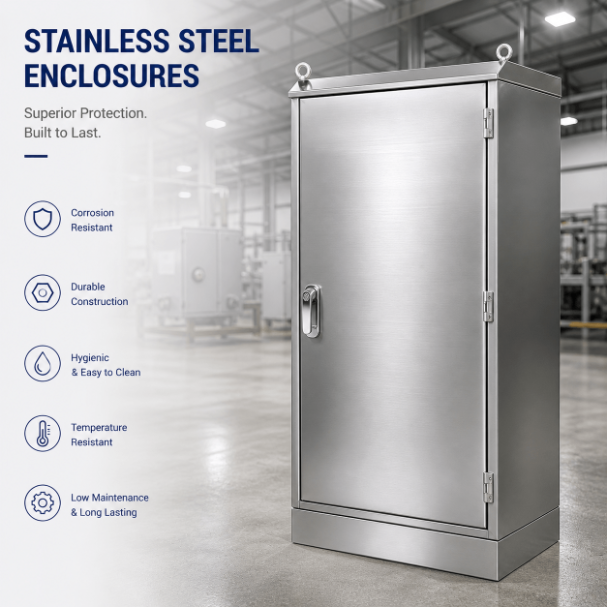
Stainless steel enclosures are a kind of corrosion-resistant protection.
Stainless Steel Enclosures
Buy a Box—Or Deploy a Long-Term Protection Strategy?
In harsh industrial environments, the enclosure itself often determines how long the electrical system survives.
Many projects initially focus only on dimensions, IP rating, or material cost. But in real-world operation, enclosure failure is rarely caused by size alone.
The real risks usually come later:
- Corrosion around cable entries
- Water intrusion after repeated washdowns
- Condensation damaging terminals
- Rust around weld seams
- Seal degradation under UV exposure
- Difficult on-site drilling damaging stainless finishes
- Poor grounding continuity
- Inadequate thermal management in sealed environments
This is why many industrial operators no longer evaluate stainless steel enclosures as simple “metal boxes.”
They evaluate them as part of the long-term reliability strategy for the entire electrical system.
At UniRegal Automation, we provide both standalone stainless steel enclosures and complete turnkey enclosure integration solutions engineered for harsh industrial environments, including food processing, water treatment, offshore systems, chemical plants, utilities, and outdoor infrastructure.
Turnkey Stainless Steel Enclosure vs Self-Managed Integration
Decision Factor | Customer Self-Procurement & Integration | UniRegal Turnkey Stainless Steel Enclosure Solution |
|---|---|---|
Total Cost of Ownership (TCO) | Lower initial purchasing cost, but higher long-term labor, field modification, and maintenance expenses. | Reduced long-term operating cost through optimized enclosure engineering, pre-machining, and environmental protection planning. |
Project Deployment Timeline | Multiple suppliers and on-site modifications often extend installation schedules. | Faster deployment with pre-configured, installation-ready enclosure systems. |
Technical Integration Risk | Higher risk of incorrect cutouts, sealing issues, grounding problems, or incompatible accessories. | Reduced integration risk through centralized engineering and CNC-prepared enclosure configurations. |
Long-Term Maintenance Complexity | Maintenance quality depends heavily on field workmanship and documentation consistency. | Easier long-term maintenance through organized layout planning and factory-prepared configurations. |
Compliance & Environmental Protection Assurance | Environmental sealing and protection quality may vary depending on site assembly conditions. | Designed around IP66/IP67 and harsh-environment protection requirements from the engineering stage. |
Supply Chain Stability | Procurement delays may occur due to fragmented sourcing of accessories, cooling, and mounting hardware. | Integrated sourcing and centralized delivery reduce project coordination complexity. |
System Scalability | Future upgrades may require additional drilling, enclosure modification, or field rework. | Expandable layouts and spare mounting considerations can be planned in advance. |
CAPEX vs OPEX Structure | Lower short-term CAPEX, but potentially higher long-term OPEX from corrosion, maintenance, and field repair costs. | Better long-term operational efficiency through reduced downtime, lower maintenance frequency, and improved enclosure lifespan. |
Why Many Stainless Steel Enclosure Projects Become Expensive Later
One of the biggest misconceptions in industrial projects is assuming that all stainless steel enclosures perform similarly.
In reality, enclosure reliability depends heavily on the following:
- Material grade selection
- Surface finishing quality
- Welding integrity
- Seal design
- Environmental compatibility
- Thermal management
- Grounding continuity
- Machining quality
Many long-term field failures begin with small details that were overlooked during procurement.
Typical problems include the following:
- Pitting corrosion in coastal environments
- Water intrusion around field-drilled cable glands
- Door seal deterioration after repeated washdowns
- Internal condensation in outdoor installations
- Surface contamination in food-grade applications
- Heat buildup inside fully sealed cabinets
That is why enclosure engineering should always match the actual operating environment — not just the purchase specification.
Why Buyers Choose Turnkey Stainless Steel Enclosure Solutions
Our turnkey enclosure systems are designed to reduce long-term operational risk, simplify installation, and improve environmental durability.
Better Corrosion Resistance Strategy
Material selection is based on actual operating conditions rather than generic specifications.
- 304 Stainless Steel for standard industrial applications
- 316L Stainless Steel for marine, wastewater, and chemical environments
CNC-Prepared Installation
Precision-machined cutouts for:
- Cable glands
- HMIs
- Conduits
- Pushbuttons
- Ventilation systems
This avoids damaging the stainless surface during field drilling.
Improved Washdown & Environmental Protection
IP66/IP67 sealing systems designed for:
- Food processing
- Outdoor utilities
- Offshore environments
- High-humidity facilities
Better Long-Term Maintainability
Well-planned mounting layouts simplify future maintenance and expansion.
Reduced On-Site Integration Complexity
Pre-configured enclosure systems reduce field modification time and installation risk.
Featured Stainless Steel Enclosure Series
Model Type | Key Specifications | Best Application |
|---|---|---|
Compact Junction Box | 316L Stainless Steel, Screw Cover, IP67 | Marine Sensors & Field Wiring |
Wall-Mount NEMA 4X | 304 / 316L, Sloped Roof Optional | Food & Beverage Washdown Zones |
Pushbutton Enclosures | Pre-Drilled 22.5mm Openings | Local Operator Stations |
Heavy-Duty Floor Stand | Dual Door, 3-Point Locking | Chemical Processing & Power Distribution |
Choosing Between 304 and 316L Stainless Steel
One of the most important enclosure decisions is material selection.
Although 304 and 316L may appear visually similar, their long-term performance can differ dramatically depending on the environment.
Choose 304 Stainless Steel For:
- Indoor manufacturing
- Standard industrial facilities
- Non-coastal outdoor installations
- General automation systems
Choose 316L Stainless Steel For:
- Offshore facilities
- Wastewater treatment plants
- Coastal environments
- Chemical processing
- High-chloride exposure
- Harsh outdoor utility systems
The additional molybdenum in 316L significantly improves resistance to chloride-induced corrosion and pitting.
Common Applications
Our stainless steel enclosure systems are widely used in:
- Food & beverage processing
- Pharmaceutical facilities
- Wastewater treatment plants
- Offshore oil & gas systems
- Chemical processing plants
- Marine environments
- Outdoor utility systems
- Renewable energy infrastructure
Designed for Harsh Global Environments
Middle East
High-temperature and high-UV industrial environments requiring durable outdoor protection.
Europe
IP66/IP67 industrial systems for chemical processing and regulated industrial facilities.
North America
NEMA 4X compatible enclosure solutions for food processing and pharmaceutical applications.
Southeast Asia
High-humidity and corrosion-prone environments requiring long-term sealing reliability.
How We Help Reduce Long-Term Operational Risk
Better Environmental Protection
Material selection and sealing systems are designed around actual field conditions.
Improved Installation Efficiency
Factory-prepared cutouts and mounting layouts reduce on-site labor and modification risk.
Easier Maintenance & Expansion
Organized internal layouts simplify future servicing and upgrades.
Reduced Corrosion Risk
Proper stainless grade selection helps reduce premature enclosure failure.
Better Project Coordination
Integrated sourcing and enclosure preparation reduce supplier fragmentation.
Download the Full Stainless Steel Enclosure Comparison Report
Looking for a deeper evaluation of 304 vs 316L enclosure strategy, IP66/IP67 protection, washdown environments, or long-term corrosion protection planning?
Download the full comparison report or schedule a technical consultation with our engineering team to discuss your project requirements.
Contact UniRegal Automation
- Email: info@uniregal.com
- Website: https://www.uniregal.com